Biographies of the Panelists
2021
Bruno Charbonneau

Bruno Charbonneau (PhD Queen’s University) is Associate Professor of International Studies, and Director of the Centre for Security and Crisis Governance (CRITIC) at the Royal Military College Saint-Jean. He is also founder and Director of the Centre FrancoPaix in Conflict Resolution and Peace Missions of the Raoul-Dandurand Chair at the Université du Québec à Montréal. Since 2015, he has been an editorial board member of the academic journal International Peacekeeping.
His work examines the power politics of and interactions between international interventions and armed conflicts. In particular, he analyses the regional and international dynamics of conflict management and resolution in the Francophone West African Sahel. He is currently working on the consequences of the “division of labor” between the international counter-terrorist forces and the UN peacekeeping forces deployed in the Sahel. He is also developing a research project on the links between armed conflict, counter-insurgency and climate change. His research has been funded by, among others, the Social Sciences and Humanities Research Council of Canada, the Organisation internationale de la Francophonie, and Global Affairs Canada.
He is the author of France and the New Imperialism: Security Policy in sub-Saharan Africa (2008), and coeditor of Peace Operations in the Francophone World: Global Governance Meets Post-Colonialism (2014), Peacebuilding, Memory and Reconciliation: Bridging Top -down and Bottom-up Approaches (2012) and Locating Global Order: American Power and Canadian Security After 9/11 (2010).
His research has been published in several world-renowned academic journals: Review of International Studies, International Political Sociology, International Peacekeeping, Les Temps modernes, Afrique contemporaine, Journal of Contemporary African Studies, Journal of Intervention and Statebuilding, Conflict, Security & Development, Canadian Journal of Political Science, and more.
Chantal Lavallée

Chantal Lavallée is Assistant Professor of International Studies and Assistant Director of Centre for Security and Crisis Governance (CRITIC) at Royal Military College Saint-Jean. Prior to this, she was Marie Skłodowska-Curie Fellow at the Institute for European Studies of the Vrije Universiteit Brussel (VUB, 2017-2019) working on “The European Commission in the Drone Community: A New Cooperation Area in the Making”. She holds a PhD in Political Science from the Université du Québec à Montréal (UQAM). She conducted postdoctoral research at the European University Institute in Florence (EUI, 2010-2012) with a scholarship from the Fonds de recherche du Québec – Société et Culture, and at the Institute for Strategic Research of the Paris-based École Militaire (IRSEM, 2015-2016) with a scholarship from the French ministry of Defense.
She is associate researcher with the Jean Monnet Centre Montréal, GRIP (Brussels) and the think tank OSINTPOL (Paris). Her research and publications focus on the contribution of the European Commission to the security and defense as well as emerging technology (drones) sectors. The book Emerging Security Technologies and EU Governance she edited with Raluca Csernatoni and Antonio Calcara for Routledge Studies in Conflict, Technology and Security Series is forthcoming.
Wesley Wark

Wesley Wark is a visiting professor at the University of Ottawa’s Graduate School of Public and International Affairs. He recently retired from the University of Toronto’s Munk School of Global Affairs, where he had taught since 1988. He served for two terms on the Prime Minister of Canada’s Advisory Council on National Security (2005-2009) and on the Advisory Committee to the President of the Canada Border Services Agency from 2006 to 2010. His most recent book is an edited volume: Secret Intelligence: A Reader (2009).
He authored a classified history of the Canadian intelligence community in the Cold War and has published extensively in the field of intelligence and security studies over the past 30 years.
He is currently completing a book on Spy Power—a history of intelligence and international relations from 1900 to the present. His essay on “Cyber-Aggression and its Discontents,” appeared in the journal Global Brief in its Fall 2012 edition (online at www.globalbrief.ca). Professor Wark writes and comments extensively for the Canadian and international media on issues relating to intelligence, national security and terrorism.
Stephen Brown

Stephen Brown is professor of political science at the University of Ottawa, where he is also affiliated with the School of International Development and Global Studies. His research focuses mainly on the intersection of the policies and practices of Northern countries and other international actors with politics in Southern countries, especially in sub-Saharan Africa. He has published on democratization, political violence, peacebuilding and transitional justice/rule of law in Angola, Kenya, Malawi, Mozambique and Rwanda.
His recent research is mainly on foreign aid, especially Canadian aid policy, for which he conducted fieldwork in Ethiopia, Ghana, Mali, Mongolia and Peru. He also conducts research on international LGBTI rights. Since 2009, he has held visiting researcher positions in Finland, France, Germany, the Netherlands, South Africa and the United Kingdom.
In 2021-2022, he will be at the University of Cambridge as a Leverhulme Visiting Professor at the Centre for Gender Studies, Department of Politics and International Studies, as well as a Visiting Fellow at Cambridge’s Centre for Research in the Arts, Social Sciences and Humanities and at Clare Hall.
Shahar Hameiri
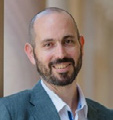
Shahar Hameiri is Associate Professor at the School of Political Science and International Studies, University of Queensland, Australia. His research interests are diverse, traversing the fields of security, development and aid, governance, political geography and international relations.
He is particularly interested in understanding the evolving nature of statehood and political agency under conditions of globalisation. He has written extensively on issues of security governance, statebuilding, non-traditional security, risk and risk management, regional governance and Australian development and security policy.
With Dr Lee Jones (Queen Mary University of London) and Prof Shaun Breslin (Warwick University), he is working on a project on rising powers and state transformation, focusing on China’s engagements in Southeast Asia. The project was awarded an ARC Discovery Project grant in 2017.
His latest book, International Intervention and Local Politics, co-authored with Prof Caroline Hughes and Dr Fabio Scarpello, was published by Cambridge University Press in 2017.
He has also co-authored Governing Borderless Threats: Non-Traditional Security and the Politics of State Transformation (Cambridge University Press, 2015), with Dr Lee Jones, and authored Regulating Statehood (Palgrave Macmillan, 2010). He received my PhD from the Asia Research Centre, Murdoch University in 2009.
Brigadier-General Simon Bernard
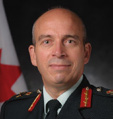
Brigadier-General Simon Bernard started his career in the Canadian Armed Forces in 1988 at Royal Military College of Saint-Jean as an infantry officer. A member of the Royal 22e Régiment, he served for more than ten years in the battalions and commanded the 2nd Battalion Royal 22e Régiment and the Citadelle de Québec.
Cumulating more than 32 years in the Profession of Arms, he has served at the tactical, operational and strategic levels. He has also served 2 years with the Allied Command Europe Mobile Force (Land) in Heidelberg, Germany.
He has deployed to Croatia under the United Nations and twice to Afghanistan. In Canada, he has served on numerous domestic humanitarian operations.
A graduate from the Centre for Advanced Military Studies of the École de guerre in Paris, BGen Bernard holds a bachelor’s degree in Administration, a Masters’ in War Studies and an Advanced Military Studies diploma from the French War College.
He is a graduate from the Joint Command and Staff Program, the French National Defense Institute of Advanced Studies and has completed the United States Capstone Military Leadership program at the US National Defense University.
Since August 2018, he is Director-General Plans at the Canadian Joint Operations Command Headquarters.
Kim Thúy

Kim Thúy holds degrees in translation and law. A writer, author and lecturer, she has worked as a seamstress, interpreter, lawyer, restaurant owner and food columnist for radio and television. Her first book, Ru, published in 2009 by Libre Expression, was a huge success upon its release. A bestseller in Quebec and France and translated into more than twenty-five languages, Ru won numerous literary awards, including the prestigious 2010 Governor General’s Award, the 2010 Grand Prix RTL-Lire at the Salon du livre de Paris, the Italian Premio Mondello per la Multiculturalità 2011, the 2010 Prix du grand public du Salon du livre de Montréal and the 2011 Archambault Grand Prix littéraire.
Ru was also a finalist for the 2010 Prix des cinq continents de la francophonie and the prestigious 2012 Giller Prize for the best Canadian book. Her latest novel, Em, was published in 2020. After 40 countries and territories, 29 languages, 765,000 copies sold, and several literary awards, Kim Thúy remains the same, faithful lover of words.
Anne Caumartin

Anne Caumartin is an associate professor in the Department of Humanities and Social Sciences at the Royal Military College Saint-Jean. Her work on Quebec literature (mainly essays and novels) addresses the conception of Quebec culture, the modalities of filiation, the notion of responsibility in literature and the relationship between memory and future perspectives.
She is a member of the CRILCQ (Centre de recherche interuniversitaire sur la littérature et la culture québécoises) and on the editorial boards of Mens. Revue d’histoire intellectuelle et culturelle and Recherches sociographiques.
2017
Mr. Serge Beauchemin
At 22 years old, Serge Beauchemin decided start his own business. With a friend and a start-up capital of 40K, he founded 3-SOFT in 1987, a firm specializing in software retail. The business experiences a spectacular growth. Under his leadership, it develops and tops a sale figure of 75$M in 2004. The next year, the business is strategically handed over to his main competitor, opening the way to investment in several businesses. He is active at the strategic level as a shareholder in businesses, offers experience and knowledge as a coach with entrepreneurs and senior leaders, and he is a keynote speaker on entrepreneurship and the importance of following one’s dreams. He is also one of the dragons of the popular television show “Dans l’œil du dragon”.
Colonel J.A.S. Bernard, CD
Born in Loretteville, Quebec, Simon Bernard began his military career at the age of 17 at the Collège militaire royal de Saint-Jean, where he held the position of Cadet Wing Commander before he obtained his diploma and Commission in 1993. He served more than ten years in the 2nd and 3rd Battalion Royal 22e Régiment, namely as Commanding Officer of the 2nd Battalion Royal 22e Régiment and the Citadelle de Québec from 2010 to 2012.
Colonel Bernard participated in three United Nations and NATO Operations abroad. In 1995, he served as platoon commander in Croatia; in 2004, as G5/G3 Plans in the Kabul Multinational Brigade in Afghanistan; and more recently, from October 2009 to September 2010, as J5 of Task Force Kandahar. At home, Colonel Bernard deployed on three humanitarian operations: following the Red River floods in Manitoba in 1997, the 1998 Ice Storm in Ontario and during the Montérégie floods in the spring of 2011 where he served as Commanding Officer of the Domestic Task Force.
In his postings outside his Regiment, he cumulated experience in staff positions, namely in the Command Suite of the Commander Land Force Central Area (LFCA) in Toronto and as Executive Assistant to the Commander of the Allied Command Europe Mobile Force (Land), NATO’s Quick Reaction Brigade, in Heidelberg, Germany. He also assumed the responsibilities of G3 of 5 Canadian Mechanized Brigade Group (5 CMBG), Executive Assistant to the Chief of Staff Land Strategy at the Army HQ in Ottawa, G3 of 2nd Canadian Division / Joint Task Force (East) and Deputy Director Current Operations at the Strategic Joint Staff.
Colonel Bernard holds a bachelor’s degree in Administration and a Masters’ degree in War Studies. He also graduated from the Joint Command and Staff Program at the Canadian Forces College.
Colonel Bernard was appointed Commandant of Royal Military College Saint-Jean in June 2015. Colonel Bernard is married to Sophie Vaillancourt from Neufchâtel, Quebec.
Colonel J.S. Boivin, OMM, MSC, MSM, CD
Col Steve Boivin enrolled into the Canadian Armed Forces in 1991 and attended the College Militaire Royal de St-Jean from 1991 to 1995 before being transferred to the Royal Military College of Canada for his final year.
Upon graduation in 1996, he was posted to the 3rd Battalion Royal 22nd Regiment in Valcartier, where he served as a Platoon Commander, Reconnaissance Platoon Commander, Company Second-in-Command and Deputy Operations Officer. During his six years of service with the 3 R22eR, Col Boivin served three six-month tours overseas: Haïti (Op STABLE), East-Timor (Op TOUCAN) and Bosnia-Herzegovina (Op PALLADIUM
In 2003, Col Boivin was transferred to the 1st Battalion Royal 22nd Regiment in Valcartier as Company Second-in-Command and Unit Technical Adjudant. In July 2004, after completion of his Assaulter course, he was posted to Joint Task Force Two (JTF 2). Col Boivin served at JTF 2 from 2004 to 2010, deploying on multiple rotations to Afghanistan with the Special Operations Task Force. He also had the chance to participate in other SOF deployments.
In August 2010, Col Boivin was posted to Toronto to attend the Joint Command and Staff Program. Upon completion of the program, he returned to Ottawa and was seconded to the Privy Council Office for one year, followed by another year with the Chief of Force Development.
In June 2013, Col Boivin assumed Command of JTF 2. Amongst other things, he had the chance to deploy to Iraq on Op IMPACT. In August 2016, Col Boivin was posted to Toronto to attend the National Security Program.
Col Boivin is married to Samanta Jacques-Arseneault, who is also a serving CAF member. They are the proud parents of two outstanding daughters.
Brigadier-General M.A.J. Carignan, OMM, MSM, CD
BGen Carignan is a Combat Engineer and graduate of the Royal Military College of Canada with a Bachelor in Fuel and Material Engineering. She commanded the 5th Combat Engineer Regiment and was deployed in Afghanistan in 2009-2010 to command the Task Force Kandahar Engineer Regiment. More recently she acted as Chief of Staff of the 4th Canadian Division and Commandant of Royal Military College St-Jean. She is currently Chief of Staff of Operations for the Canadian Army.
Brigadier-General Carignan’s overseas assignments include deployments to Bosnia-Herzegovina, the Golan Heights, and Kandahar, Afghanistan.
Brigadier-General Carignan is a graduate of the United States Army Command and General Staff College and the School of Advanced Military Studies, where she earned a master's degree in Military Arts and Science. In 2016, she graduated from the National Security Studies Programme. In addition, she holds a master’s degree in business administration from Université Laval.
Brigadier-General Carignan has received the Meritorious Service Medal for her service in Afghanistan, the Major-General Hans Schlup Award for excellence in international relations, the Hermès Award as well as Gloire de l’Escole Medal from Université Laval for career achievements. In 2011 she was recognized as one of Canada’s Top 100 Most Powerful Women. She is married and the mother of four children.
Commodore L. Cassivi, OMM, CD
Commodore Luc Cassivi was born and raised in the Gaspé Peninsula, Québec. His experience in the Royal Canadian Sea Cadets led his to join the Canadian Armed Forces in 1983. He received an undergraduate degree in Computer Science with a specialization in Operations Research in 1988 from the College Militaire Royal de St-Jean.
Upon graduation, he underwent naval training and performed various duties ashore and at sea in both the surface and submarine fleets. He also served on exchange with the Royal Australian Navy in Her Majesty’s Australian Submarine (HMAS) Onslow and as an instructor at the Submarine Warfare and Systems Centre in Sydney Australia.
After his tour as Executive Officer of HMCS Corner Brook (ex-Her Majesty’s Submarine Ursula), Commodore Cassivi challenged the Royal Netherlands Navy’s Submarine Command Course in 2004. He was the first Canadian to graduate from this course. Commodore Cassivi enjoyed command appointments in HMCS Victoria, HMCS Corner Brook and HMCS Windsor before assuming the duties of Commander Submarine Division and Officer in Charge of the Submarine Sea Training Group. He also had the pleasure of commanding HMCS Ville de Quebec before proceeding to the United States Naval War College, Naval Command College in Newport, Rhode Island as part of the class of 2011.
On return to Canada, he served as Deputy Commander Canadian Fleet Pacific, Director Canadian Submarine Force, Chief of Staff Plans and Operations for Maritime Forces Pacific and Joint Task Force Pacific, and Commanding Offcier Canadian Forces Base Esquimalt.
Promoted to Commodore he assumed the position of Director General Naval Strategic Readiness at National Defence Headquarters in August 2014.
Commodore Cassivi received a Masters in Business Administration in November 2008 from the Edinburgh Business School, Heriot-Watt University, Edinburgh, Scotland. Luc shares his life with his partner.
Mr. Jacques Duchesneau, C.M., C.Q., C.D., Ph. D.
Jacques Duchesneau cumulated more than 30 years of experience in various executive and management positions. He built a solid expertise in Police operations, air security and fight against corruption. He is known for his sound problem solving skills and for overcoming the challenges associated with the mandates with which he is entrusted. He successfully conducted the reorganization of several public and private businesses.
Mr. Duchesneau had a 30-year career at the Montreal Police Service, of which he assumed command as Director. Following the 9/11 attacks, he was appointed Chair and Chief Officer of the Canadian Air Transport Security Authority (CATSA) and was responsible for pre-boarding screening procedures in 89 airports of the country. He also led the Anti-collusion Unit of the Quebec Transportation Department and was elected Member of Parliament at the National Assembly of Quebec.
He was honoured with the following distinctions: Order of Canada (C.M.), Ordre de Saint-Jean (KStJ), National Order of Quebec (C.Q.), Ordre national du mérite de la République française and the Canadian Forces Decoration (C.D.). He holds a master’s in Public Administration from the École nationale d’administration publique (ÉNAP) and a Ph. D. in Military Studies from Royal Military College of Canada in Kingston, Ontario. The title of his thesis is Air Terrorism —Preventing High Impact Improbable Attacks (Terrorisme aérien — Contrecarrer des attaques improbables à impacts élevés).
Brigadier-General S.G. Friday, OMM, MSM, CD
Brigadier-General Sean Friday joined the Canadian Forces in 1985 and graduated from the Royal Military College in 1989. Following Air Navigator wings training, early operational postings involved advanced tactical air mobility missions and air-to-air refueling missions around the globe.
BGen Friday has amassed 3500 flying hours including deployments during the Gulf War, operations in Ethiopia, Somalia, three rotations to Bosnia-Herzegovina, Kuwait and, most recently, Afghanistan. In Canada, BGen Friday has flown operations from coast to coast and to the farthest reaches in the North.
BGen Friday has commanded 435 Squadron in Trenton, Theatre Support Element – Camp Mirage, and 8 Wing Trenton. Staff appointments have included an exchange with the United States Air Force in San Antonio, Texas; he has held several positions in National Defence Headquarters, amongst them: Director General Air Readiness, and acting Deputy Commander RCAF. BGen Friday assumed his current position as the Commandant and Vice-Chancellor of the Royal Military College of Canada in May 2015.
BGen Friday is a graduate of the Air Force's Aerospace Systems Course and the National Security Program. He holds a bachelor's degree in Mechanical Engineering from RMC and an Executive MBA from Queen's University.
Mrs. Danièle Henkel
Chief Executive Officer Danièle Henkel Inc.
A woman of heart and action recognized for her business acumen, determination and audacity, her qualities pulled her to the rank of pioneer in the medical-aesthetic field.
Danièle Henkel founded her eponymous company in 1997. Passionate, authentic and empathic, the businesswoman inspires, shares and transmits her experience through lectures, books and television, where her audacity, integrity and her great skills as a communicator have moved the participants as much as the viewers of the television show “Dans l'oeil du Dragon”.
Since 2000, she has received numerous awards, including Woman Entrepreneur of the Year from the Réseau des femmes d’affaires du Québec, the Medal of the National Assembly of Quebec, the Tribute Award of the Women's Y Foundation of Montreal. Chair of the Board of Directors of the Société du parc Jean-Drapeau, the fundraising campaign for Sclérodermie Québec and the major donations campaign for the Wilder Building's Espace Dance, she is dedicated to promoting the place of women and youth in the labor market and to be a citizen committed to restoring the will of the population to actively engage in the well-being of their community.
Recently, Mrs. Henkel was honoured with the title of Chevalier of the National Order of Merit by the French Republic as a business leader.
Lieutenant-General (ret) Michel Maisonneuve
Michel Maisonneuve assumed the position of Academic Director of Royal Military College Saint-Jean on 3 December 2007.
Lieutenant-General (retd) Maisonneuve specializes in issues of international security, executive leadership and management, and educational development. In May 2007, he completed 35 years of active service in the Canadian Armed Forces. After graduating at the top of his class from the Royal Military College of Canada in 1976, he distinguished himself in progressive leadership positions in Canada and abroad. Most notably, he served on staff and as an operational commander in missions ranging from humanitarian relief to conflict operations.
Recently, LGen Maisonneuve held the position of Chief of Staff of NATO's Allied Command Transformation in Norfolk, Virginia. He was the first senior Canadian assigned to stand up this new global Command responsible for the strategic transformation of NATO's military capabilities.
Previously, as Assistant Deputy Chief of the Defence Staff of Canada, LGen Maisonneuve was responsible for support to all Canadian Armed Forces operations in Canada and internationally. After the events of September 11, 2001, he was deployed to the United States on behalf of the Canadian Armed Forces, to coordinate Canada's response to the campaign against terrorism with the U.S.
LGen Maisonneuve provided leadership and guidance to numerous UN and OSCE humanitarian and international peacekeeping missions. He has worked collaboratively with leading academics and experts on democratization, international security and counter-terrorism as well as with senior leaders from NATO and the OSCE to promote international relations.
He is the recipient of several awards and titles from Canada, including Commander of the Royal Order of Military Merit and the Meritorious Service Cross. Foreign awards in recognition of his exemplary service include Officer of the French Legion of Honour, Officer of the U.S. Legion of Merit and the NATO Meritorious Service Medal.
In 1992 he was seconded to the Canada 125 Corporation as Chief of Programs, co-ordinating the nationwide commemoration of Canada's Confederation and managing two thirds of the Corporation's budget; one of the legacy programs was the creation of the TransCanada Trail.
As an educator, LGen. Maisonneuve is an International Senior Fellow of the U.S. Joint Forces Staff College in Norfolk Virginia and a frequent lecturer on international affairs and defence policy. He is a sought-after educator and facilitator on strategic leadership, change management and organizational transformation.
LGen Maisonneuve is a graduate of the Canadian Forces Command and Staff College and a Hall of Fame graduate of the U.S. Armed Forces Staff College. He holds both an undergraduate Honours B.A. and a Master of Arts degree in Defence Management and Policy from the Royal Military College of Canada.
Mr. Luc Maurice
If Luc Maurice makes a strong impression with his imposing stature, his contagious smile and his great humanity, he is also a communicator who knows how to create a warm atmosphere, giving his wonderful energy to his residents and team.
His passion for retirement homes is a long-standing one. At a young age, his father initiated him to construction, but upon completion of his studies at Royal Military College Saint-Jean, he decided to embrace a career in the Canadian Armed Forces that brought him in West Canada as a pilot at the head of a flight. He pursued his military career in Ottawa as Aide de Camp for the then Governor General Jeanne Sauvé.
Luc Maurice maximized this posting by attending the University of Alberta and started a Masters in Business Administration (MBA), with a specialization in marketing and quantitative techniques. His thesis focused on optimizing retirement homes.
So it was natural for him to decide to form Le Groupe Maurice in 1998. Since then, Luc Maurice designs, builds and manages quality residential complexes for seniors seeking comfort, autonomy and security, a mission that drives and inspires him, all the while enriching his life with new knowledge and contentment.
Seniors are at the heart of his daily life and at the center of his every concern. This is the passion that Luc Maurice strives to instill into his team in order make every single one of their actions a way of give back to the residents the great energy they so generously bring to his life.
Commissioner Paulson
Commissioner Bob Paulson joined the RCMP in 1986 in Chilliwack, British Columbia. Prior to joining the RCMP, Commissioner Paulson served for almost seven years in the Canadian Armed Forces.
From 1986 to 2005, Commissioner Paulson policed in various locations in British Columbia at the municipal, provincial and federal policing levels. This included work related to frontline service delivery, major crime & unsolved homicides, aboriginal and community policing, and investigating serious and organized crime. In 2005, Commissioner Paulson transferred to National Headquarters in Ottawa, where he served in the Major and Organized Crime Intelligence Branch and then National Security Criminal Operations. In November 2008, he was promoted to Assistant Commissioner in charge of National Security Criminal Investigations and then Assistant Commissioner, Contract and Aboriginal Policing Services. In November 2010, he was appointed Deputy Commissioner, Federal Policing.
Commissioner Paulson became the 23rd Commissioner of the RCMP on November 21, 2011. His focus since becoming Commissioner has been on the primacy of RCMP operations and on delivering results to Canadians through renewed emphasis on leadership and accountability.
Senior Associate Deputy Minister Jody Thomas
Ms. Jody Thomas was appointed Senior Associate Deputy Minister of the Department of National Defence on March 13, 2017.
Ms. Thomas has broad and varied experience working at senior levels in the Public Service. Prior to serving as Commissioner of the Canadian Coast Guard (CCG), Ms. Thomas began her career in the Public Service in 1988 when she was appointed Chief of Business Planning and Administration with Public Works and Government Services Canada’s Atlantic Region.
Ms. Thomas then moved to the West Coast as the Business Manager of the Esquimalt Graving Dock in Victoria, British Columbia. From 1995-2010, she joined Passport Canada where she served as Manager of the Victoria Passport Office. This led to a number of senior roles within the Passport Office, culminating in Chief Operating Officer, where she managed service delivery at 35 locations involving 3,000 employees across Canada.
In 2010, Ms. Thomas joined the Canadian Coast Guard where she held the position of Deputy Commissioner of Operations for four years, during which she provided leadership and functional direction in the development of the Coast Guard’s strategic and operational policy frameworks, monitored their implementation and ensured the strategic direction for the cost-effective delivery of Coast Guard programs. In September 2014, Ms. Thomas was appointed as Special Advisor to the Deputy Secretary to the Cabinet (Operations) at the Privy Council Office until her appointment as Commissioner of the Coast Guard on January 1, 2015.
Ms. Thomas currently holds a commission in the Navy (Naval Reserve). She also holds a Bachelor of Arts from Carleton University.
The Senior Associate Deputy Minister (Sr Assoc DM) is a senior civil servant assigned to the Department of National Defence. The Governor-in-Council (the Cabinet) may appoint not more than three Associate Deputy Ministers of National Defence, each of whom shall have the rank and status of a deputy head of a department and as such shall, under the Minister and the Deputy Minister (DM), exercise and perform such powers, duties and functions as deputy of the Minister and otherwise as the Minister may specify.
- Date modified: